Introduction
India’s manufacturing sector is entering a new phase with automation, smart logistics, Industry 4.0 and large scale industrial expansion. Modern factories aren’t just designed for production anymore—they’re designed for speed, scalability, energy efficiency, and intelligence of operation.
This is changing how industrial infrastructure is planned in the country. Modern manufacturing ecosystems demand a level of flexibility and execution speed that traditional RCC-based industrial construction, while reliable in certain applications, often falls short of.
This is why smart factories in India are increasingly opting for Pre-Engineered Building (PEB) structures over conventional buildings.
From automotive plants and engineering units to logistics parks and automated warehouses, infrastructure that supports: is a top priority for industrial developers
Faster project delivery
Large clear span layouts
Compatibility with automation
Expansion in the future
Reduced lifecycle cost
Energy efficient operations
For industrial construction companies such as Eco Plus, this transformation is the future of engineering led infrastructure development in India.
What Is a Smart Factory?
A smart factory is a manufacturing facility that integrates advanced technologies into production and operations. These facilities use:
Automated machinery
Robotics
IoT-enabled systems
AI-driven monitoring
Smart material handling
Real-time operational analytics
Unlike traditional manufacturing setups, smart factories require infrastructure that can adapt quickly to operational upgrades and future expansion.
This is where PEB structures provide a major advantage.
What Is a PEB Structure?
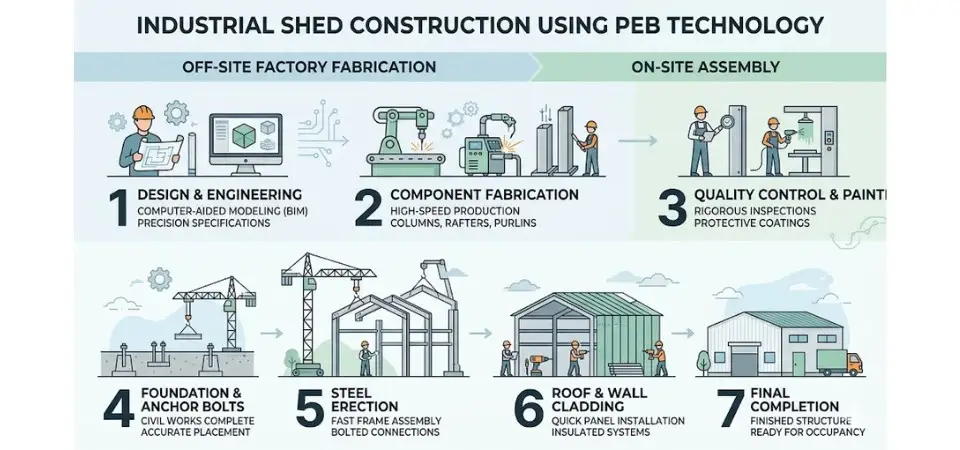
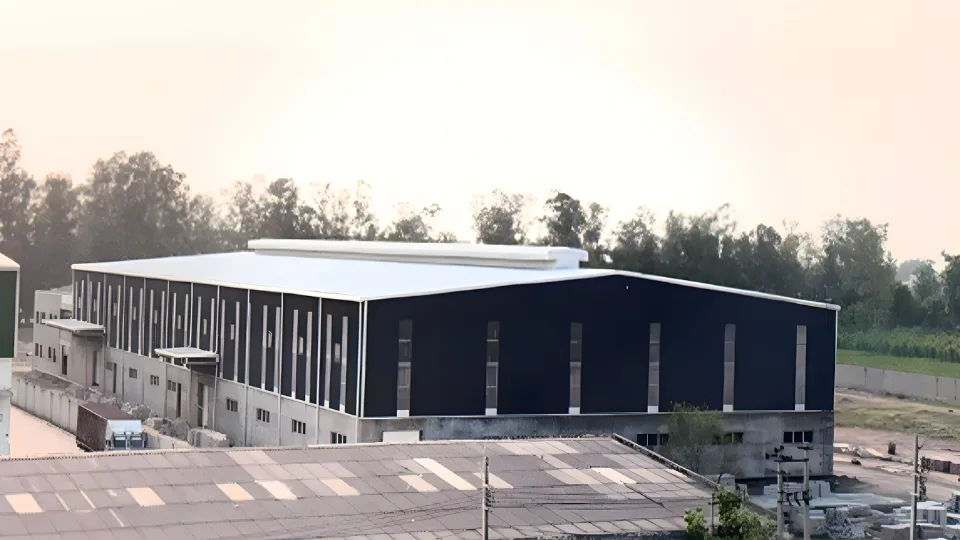
Pre-Engineered Building (PEB) is a steel structure, designed and fabricated in a factory under controlled conditions, and erected at the project site.
The typical PEB systems are:
Main steel structure
Purlins and girts
Cladding and roofing systems
Structural systems
Solutions for rooflights and ventilation
As these components are pre-fabricated, PEB structures provide better accuracy, faster erection and optimized structural efficiency.
Why Conventional Industrial Buildings Are Losing Relevance
Traditional RCC construction has been widely used in industrial projects for decades. However, modern manufacturing demands have exposed several limitations in conventional industrial buildings.
These include:
Longer construction timelines
Limited flexibility for expansion
Higher structural weight
More dependency on on-site labor
Difficulty in accommodating automation layouts
Increased maintenance over time
Smart manufacturing facilities need infrastructure that can evolve alongside production technology.
PEB systems are designed specifically for this level of industrial adaptability.
Why Smart Factories Prefer PEB Structures
1. Quicker Build Times
Today, manufacturing time directly impacts profitability.
Infrastructure delays imply:
Production maintained
Supply chains delayed activation
Revenue generation postponed
Speed – one of the major advantages of PEB construction.
The structural components are manufactured in factories and erected on site. The project time is much less than RCC construction.
This is a huge competitive advantage for industries looking to launch operations quickly.
2. Large Clear Span Layouts
Modern factories require uninterrupted floor space for:
Automated production lines
Conveyor systems
Robotic movement
Heavy machinery
Flexible workflows
PEB structures support large clear spans without excessive internal columns.
This improves:
Space utilization
Workflow efficiency
Machinery movement
Future production reconfiguration
Traditional RCC layouts often create limitations for highly automated manufacturing environments.
3. Industry 4.0 Compatibility
Industry 4.0 is transforming manufacturing through digitalization and automation.
Smart factories increasingly depend on:
IoT integration
Real-time monitoring systems
AI-enabled production control
Smart warehousing
Data-driven operational planning
PEB structures support these systems more effectively because they allow flexible layout integration and future infrastructure modifications.
This makes them ideal for technology-driven industrial facilities.
4. Scalability For Future Growth
Manufacturing businesses are rarely static.
As operations increase factories may need:
Add. production lines
New storage spaces
Warehouse extensions
Logistics infrastructure, expanded
PEB structures are scalable for future expansion.
Additional bays and extensions can often be added with little disruption to operations.
This is one of the strongest reasons why developing industries favor steel-based infrastructure systems.
Role of PEB Structures in Automated Warehousing
India’s logistics sector is expanding rapidly because of:
E-commerce growth
Industrial corridor development
Faster supply chain requirements
Smart inventory systems
Modern warehouses now rely on:
Automated racking systems
Robotic movement
High vertical storage
Smart inventory tracking
PEB structures are naturally suited for these facilities because they provide:
High roof clearance
Large spans
Flexible layouts
Better operational efficiency
This is why most modern logistics parks now prefer engineered steel structures over traditional industrial construction.
Energy Efficiency and Sustainable Industrial Infrastructure
Sustainability is becoming a major priority in industrial development.
Manufacturing companies increasingly focus on:
Lower energy consumption
Reduced environmental impact
ESG compliance
Sustainable infrastructure
PEB structures support these goals through:
Energy-efficient roofing systems
Insulated wall panels
Natural ventilation integration
Solar-compatible roofing
Reduced material wastage
Since steel components are recyclable, PEB systems also contribute to environmentally responsible construction practices.
Why Roofing Systems Matter in Smart Factories
Industrial roofing impacts:
Internal temperature
Worker comfort
Machinery efficiency
Energy consumption
Modern PEB structures support advanced roofing technologies such as:
Standing seam roofing
Ridge ventilators
Skylight systems
Thermal insulation panels
These features help improve operational efficiency inside manufacturing plants.
Traditional roofing systems often struggle to provide the same level of performance in high-load industrial environments.
Operational Cost Benefits of PEB Structures
Modern businesses no longer evaluate infrastructure only on initial construction cost.
They also consider:
Operational efficiency
Maintenance expenses
Lifecycle durability
Expansion flexibility
PEB structures help optimize long-term operational cost through:
Reduced maintenance
Faster project completion
Better energy performance
Efficient structural design
This improves overall return on investment for industrial projects.
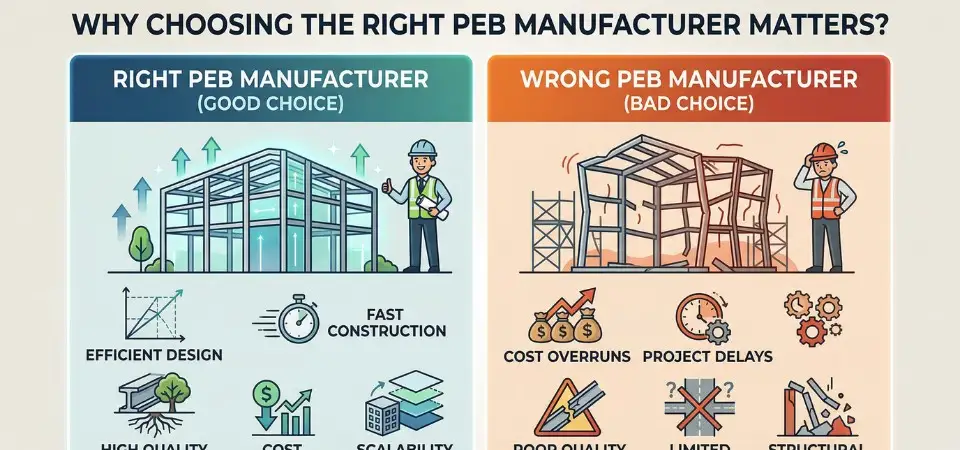
Why Engineering Expertise Is Critical
The success of smart industrial infrastructure depends heavily on engineering quality.
A professionally engineered PEB structure ensures:
Structural safety
Optimized steel usage
Efficient load distribution
Long-term performance
Future scalability
This is why industries increasingly prefer engineering-driven construction partners instead of conventional fabricators.
Companies such as Eco Plus focus on delivering industrial infrastructure solutions aligned with modern manufacturing and logistics requirements.
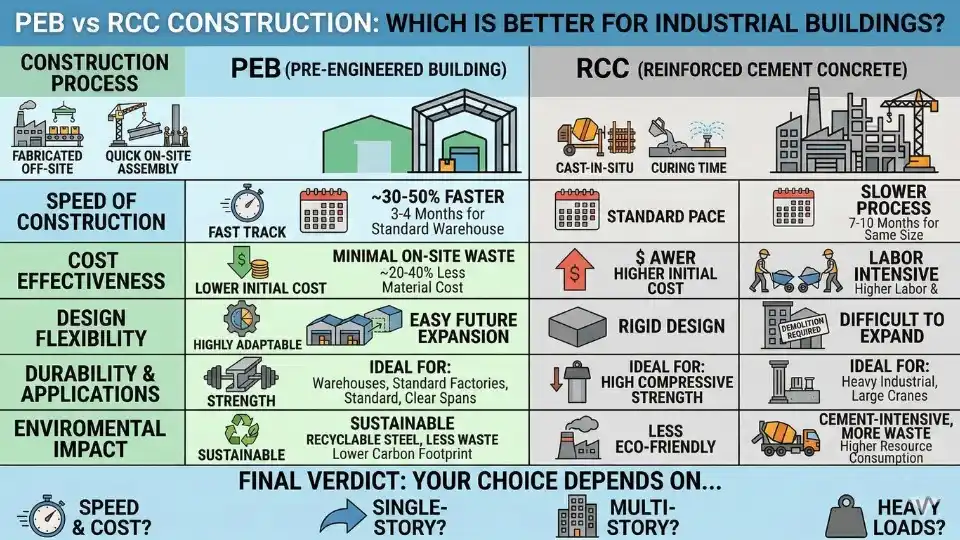
PEB vs RCC for Smart Factories
| Factor | PEB Structure | Conventional RCC |
|---|---|---|
| Construction Speed | Faster | Slower |
| Expansion Flexibility | High | Limited |
| Automation Compatibility | Excellent | Moderate |
| Clear Span Capability | Excellent | Limited |
| Structural Weight | Lower | Higher |
| Lifecycle Maintenance | Lower | Higher |
| Scalability | Easy | Complex |
For smart industrial infrastructure, PEB systems offer significantly better operational flexibility.
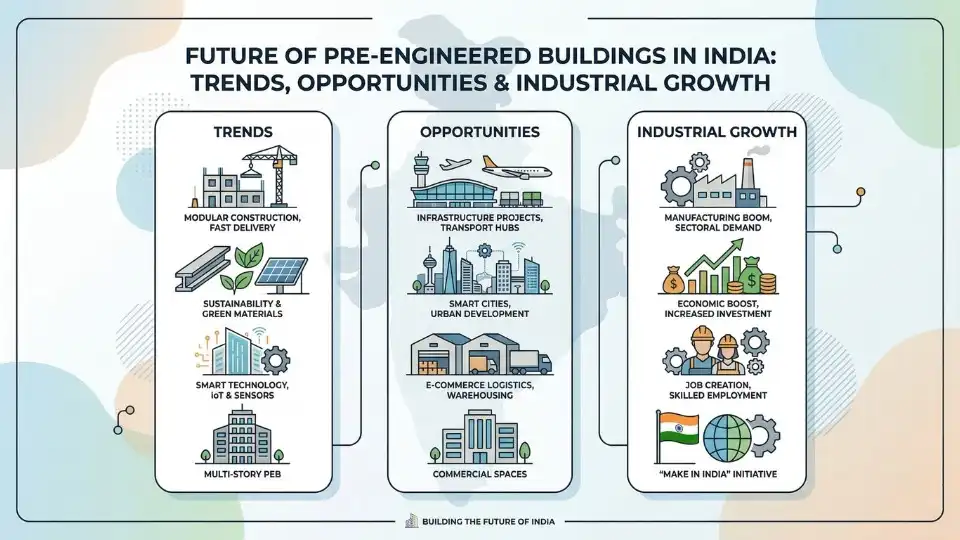
Future of Smart Industrial Infrastructure in India
India’s manufacturing ecosystem is rapidly evolving due to:
Industrial automation
Smart logistics expansion
Digital manufacturing
Global supply chain integration
Infrastructure modernization
The future will increasingly favor:
Faster construction systems
Lightweight industrial structures
Smart factory-ready infrastructure
Sustainable industrial development
PEB systems align perfectly with these requirements.
As more industries shift toward automated operations, the demand for advanced steel infrastructure will continue to rise.
Frequently Asked Questions (AEO Optimized)
Why are smart factories choosing PEB structures?
Smart factories prefer PEB structures because they provide faster construction, flexible layouts, automation compatibility, and easier future expansion.
Are PEB buildings suitable for automated manufacturing plants?
Yes. PEB structures support large clear spans, heavy machinery loads, and flexible layouts required for automated manufacturing.
Is PEB construction better than RCC for industrial projects?
For modern industrial infrastructure, PEB systems often provide better scalability, faster execution, and improved operational efficiency.
Can PEB structures support future factory expansion?
Yes. One of the biggest advantages of PEB systems is easy future expansion with minimal operational disruption.
Internal Linking Strategy for SEO
To strengthen topical authority for ecoplus.co.in, this blog should internally link to:
What Is a Pre-Engineered Building (PEB)?
PEB vs RCC Construction
Industrial Shed Construction Using PEB Technology
Future of PEB Buildings in India
Cost of PEB Buildings in India
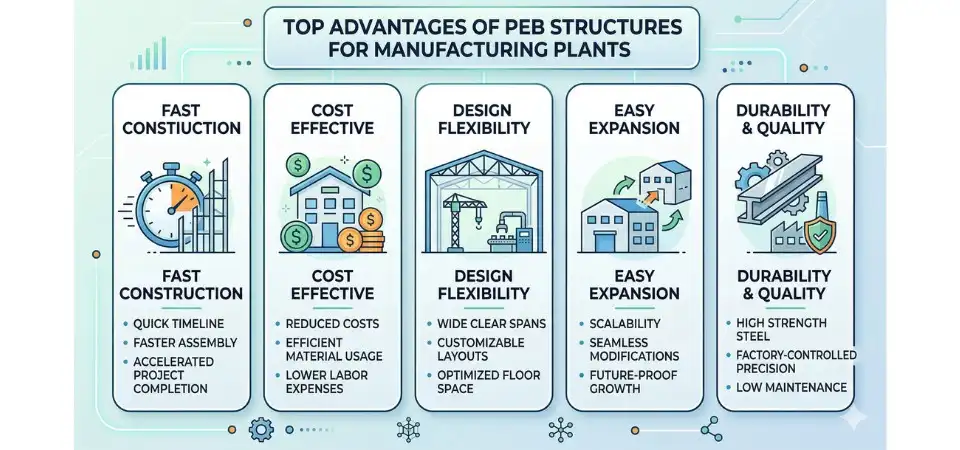
Advantages of PEB Structures for Manufacturing Plants
This creates a strong semantic SEO structure around industrial construction and smart infrastructure.
Conclusion
India’s manufacturing sector is entering a technology-driven era where infrastructure must support automation, scalability, efficiency, and rapid operational growth.
Traditional industrial construction methods are increasingly struggling to meet these evolving requirements.
PEB structures provide a smarter alternative through:
Faster execution
Flexible layouts
Better scalability
Energy-efficient systems
Automation-ready infrastructure
This is why smart factories in India are rapidly moving toward engineered steel building systems.
For businesses planning future-ready industrial facilities, choosing the right infrastructure approach is no longer just a construction decision—it is a strategic business investment.
As industrial development accelerates across India, PEB technology is expected to play a defining role in the next generation of manufacturing infrastructure.